
Maxsold - Get in on the auction!
BlogPartner with Maxsold

Are you looking to

Return to auction

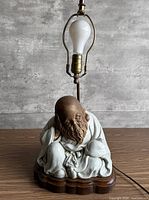
Lot #35: Vintage LJ Japan Large Ceramic Japanese Monk Mud Man Lamp
Current bid

$0.00

Time Remaining:

10d left

Location:

East Main Street, Los Gatos, California 95030

Pickup:

Sun, May 03 2026

22" x 10" x 10". The figurines are commonly known as mud figures or figurines, mud people, mud men, mudd men, or mudmen. Over 1000 years ago, Chinese artisans during the Tang Dynasty (618-907 AD), were creating landscape bonsai, miniature landscapes in a tray, a practice known as Pen’Jing. To capture the realism of a favorite countryside or mountain scenic view, the artists added rocks and planted small trees in a large ceramic tray to simulate the panorama on a smaller scale. These were intended to invoke a harmonious feeling to the viewers. In an effort to capture the illusion, the Chinese artisans used figurines of people, animals, huts and temples, which gave an appearance of great age and size to the miniature forests. Figurines have had a place in bonsai as a visual contribution. Pen’Jing, nearly a lost art form, is experiencing a revival in modern day China and is once again popular with Chinese bonsai enthusiasts. The prosperous Manchurian Ch’ing Dynasty (1644-1912) began declining at the end of the 18th century. The successful export market for fine china was impaired by excessive competition for the wares. Pottery and figurines dominated the Chinese export trade well into the next century. Mud figures thrived, as they were different from ordinary figurines. They were made individually by hand and involved nearly all members of the village. Mudmen were brightly glazed figurines of men, women, wise men and old sages, seated or standing, holding flutes, scrolls, pots, fish and other objects of mystical importance or sometimes fishing. After completion of the rice harvest and the dry season set in, villagers turned to figurine production to stimulate the economy. For smaller ones, the artist just picked a small piece of mud and in no time made a figurine out of it by using their two fingers. For the average-sized figure, the ‘mud’ or clay for the figures was pressed into a mold by hand. Each part was individually molded and assembled by various crafters at the appropriate time — thus, the varying degrees of quality in the pieces. Once the torso was removed from the mold, the extremities — head, hands and legs or feet — were added, along with the hair, hats, beards and other items. To add further detail, eyes, nose and ears would be pierced. Then the entire collection was fired in a kiln to cure the clay. Fingerprints can often still be seen, immortalized in the fired clay. Each mudman was hand painted with a low temperature lead glass glaze in yellow, blue or green glaze with the occasional use of white or brown. The face, hands and feet were left unglazed to expose the natural color of the mud. The rocks, shoes or sandals were painted with a dark brown, almost black under-glaze, that was often used to paint hair and facial features as well. Occasionally the rocks were painted a red oxide or yellow ochre. In the late 19th century to the mid 20th century, mud figures continued to be produced in South China, with the exception of the popular water carrier, which originated in Jiwah, near Hong Kong. The smallest figures were used as backdrops in fish tanks or bonsai, while the larger figures were used in planters. The exceptionally large muds were sometimes made into lamp bases. The larger figures can be found at Stone Bay of Kwangtung. These figurines can cost thousands of dollars if they are made by the masters. Today, the antique mud man is a highly collectible item. Surviving examples were showcased in a large exhibition at the Hong Kong Fung Ping Shan Museum in 1979 and at the Chinese Culture Centre in San Francisco in 1994. Mud women are much rarer to find. Pickup category timeslot {A}

Be the first one to ask a question

Picking up your new treasures should be just as easy as bidding on them! For a smooth pickup experience, keep these tips in mind:

1. Double-check that you have everything from the lots you've won before you leave the pickup location.

2. For invoices over $300, you will need to show a photo ID and credit card used for purchase for verification.

3. If you have any questions at pickup you can always ask our Maxsold Team Lead or the Seller managing the pickup.


Only Available Pickup Date/Time: Sun, May 03 2026

Category A: 10:00 AM - 12:15 PM

Pickup Location:  East Main Street, Los Gatos, California 95030 View Map (opens in new window)


Bidding Starts:

Tuesday, April 21, 2026 at 12:00:00 AM UTC

Bidding Ends:

Saturday, May 2, 2026 between 3:00:00 AM and 3:30:00 AM UTC

See individual items for exact closing times.

Bid not placed yet.

Policies for Pickup