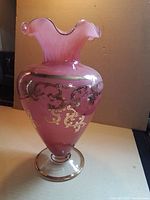
Hand-blown "cased" glass with 24k gold encrusted scrollwork 6x13"
I'm offering a beautiful, hand-blown "cased" glass vase, adorned with intricate 24k gold encrusted scrollwork. This elegant piece measures 6x13 inches and is in excellent condition. It would make a stunning addition to any collection or a sophisticated accent to your home decor.
Key Features and Identification
Type of Glass:
Cranberry glass (sometimes called "ruby glass") is created by adding gold salts to molten glass, which results in the characteristic pink-to-red color.
Style and Origin: Vases with this specific combination of a ruffled rim and dense scrolling decoration are most commonly associated with Venetian (Murano) or Bohemian glassmakers from the mid-20th century (circa 1940s–1960s).
Venetian/Murano: Often identified with brands like Vecchia Venice or "Veneto" glass, which frequently utilized these elaborate metallic overlays.
Bohemian: Produced extensively in the Czech Republic, often featuring "flashed" cranberry glass (a thin layer of color over clear glass) with hand-painted or etched designs.
Based on the intricate scrolling pattern and the "cranberry" base color, the vase is likely one of the following:
Bohemian Art Glass: Many vintage Bohemian cranberry glass vases feature this exact type of raised gold scroll design. These were often produced by studios like Moser (Czech Republic) in the early 20th century.
Venetian/Murano (Tre Fuochi style): This "Three Fires" technique involves multiple kiln firings to fuse the glass, the gold, and any hand-painted details. Murano Tre Fuochi vases from the 1960s often use similar 24k gold finishes.
Italian Art Glass (Arte Italica style): Some mid-century Italian pieces, like those from Arte Italica , used similar gold-encrusted designs on pink glass bodies
The view from the top reveals a feathered or "swirled" texture within the glass, which is common in hand-blown art glass from the mid-20th century.
Because the color isn't a solid, uniform "cranberry" but instead has those white-to-pink wisps, this piece is very likely Venetian (Murano) glass or Bohemian glass that has been "cased"—meaning a layer of colored glass was fused with a layer of white or clear glass.
Key Observations:
The Rim: The ruffled (crimped) edge is consistent with the "Tre Fuochi" (Three Fires) style mentioned earlier, popular in Murano, Italy.
The Texture: That streaky, feathery look is often found in "Alabastro" or "Opaline" glass, which was a specialty of Italian makers like Venini or Seguso, though it was also widely imitated.
Condition Check: Looking down the neck, the gold/silver scrollwork on the outside seems very well-preserved.
The circular mark on the base of the vase features a fleur-de-lis, which is a classic heraldic symbol frequently used by high-end European glassmakers.
Potential Makers
Based on the fleur-de-lis motif and the high quality of the vase, two makers are the most likely candidates:
Steuben Glass Works: Steuben used an etched fleur-de-lis logo on many of its luxury art glass pieces. Their mark is typically quite detailed and etched into the glass rather than molded.
Cristalleries de Saint-Louis: This prestigious French manufacturer often uses a circular acid-etched mark that includes the name "Saint-Louis" and sometimes a fleur-de-lis variant, especially on mid-20th-century pieces.
Stevens & Williams: This British company, later known as Royal Brierley, is also known to have used a fleur-de-lis motif alongside "ENGLISH MADE" on some specialized lines
Summary of Identification
Cased Pink/White Glass
Hand-blown, mid-century origin.
Raised Gold Scrollwork
High-end decorative technique (likely 24k).
Smooth Polished Base
Skilled artisan finishing; common in Murano or fine Bohemian glass
The way the clear base is fused to the pink body is a classic "stuck shank" technique, confirming this is a hand-blown art glass piece. Mass-produced glass is typically one solid mold, but high-end European makers crafted these in multiple parts
Final Identification Recap
Everything about this vase points to a prestigious mid-20th-century European glasshouse, most likely Cristalleries de Saint-Louis (France) or a top-tier Murano studio (Italy) utilizing the "Tre Fuochi" style.
Materials: Hand-blown "cased" glass (pink over white/clear) with 24k gold encrusted scrollwork.
The Mark: The circular fleur-de-lis on the base is your "smoking gun" for quality. It separates this from common giftware and elevates it to a collector's item.
Pickup category timeslot {A}